Posts

CRECE-Empleo - Every little helps

Image
Fifteen Alcalá women, who have all been unemployed for some time, have something to celebrate this week. They have been selected to take part in a nine-month training programme on basic restaurant and bar skills, comprising six months' theory followed a further three months' work experience in local businesses. During that time they will receive a grant of €400 a month. At the end of the period they will get a certificate (but no guarantee of a job).  A further 125 Alcalá residents considered "at risk of social exclusion", including some with physical or mental disabilities) will get help from coordinators who will liaise with local businesses to find them placements according to their abilities. The Chosen Few (plus a handful of politicians) This project, known as CRECE-Empleo , is being funded 80% by the European Social Fund and 20% by the Diputación de Cádiz.   It is part of a further injection of EU funds to help the chronic unemployment situati...

Feria in the '50s

Image
Alcalá's August fair is one of the highlights of the festive calendar, with friends and families getting together for four days of eating, drinking, loud music, dancing and general merriment.   But it wasn't always like that and it wasn't always in August.   Francisco Teodoro Sánchez Vera , an alcalaíno now living in Catalonia, describes the ferias he remembers from his childhood.   Read the original Spanish version here  During the years of my childhood and adolescence in Alcalá, there was no fair in August. It was celebrated in May, and it was very different to nowadays. In those days the girls didn't wear dresses with frills, and you didn't hear sevillanas 1 on the Paseo de la Playa. We had song and dance del gazpacho 2 to the rhythm of verdiales or pasodobles, played by local groups with well-known musicians like my friend Jésus Sánchez, father of the great Alejandro Sanz. 3 There were also f lamenco shows in the Cinem...

La Vuelta Ciclista - on yer bike, Alcalá!

Image
Spain's international cycling road-race, La Vuelta a España , kicked off yesterday in Jerez de la Frontera.  Over the next three weeks nearly two hundred men on wheels will punish their bodies relentlessly over some of Spain's hairiest mountain passes, ending up in Santiago de Compostela.  There is much local excitement because the first three stages are taking place in Cádiz province.Today they are touring the Costa de la Luz, from Algeciras to San Fernando, and tomorrow's stage sets off from a Spanish aircraft carrier moored in the port of Cádiz. (This is ostensibly to honour Spain's former monarch , who abdicated recently after a series of scandals.  He's kept his job as head of the armed forces, but his relationship with cycling is unclear.) Stage 2 - a nice flat bit The third stage was supposed to come through Alcalá de los Gazules, on the way to Arcos de la Frontera via the daunting crags of the Sierra de Grazalema.  Cycling fans and local hostelries ...

Stork Talk

Image
One of the most impressive large birds seen regularly around Alcalá is the white stork, Ciconia ciconia . The other day we witnessed about two hundred of them flying overhead, on their way from wintering in Africa to their breeding grounds in Europe. They take the shortest route across the Mediterranean, because the thermals which lift them high into the air during their migration don't form over water. An estimated eighty thousand of them come our way, across the Strait of Gibraltar, though many more cross at the other end of the Med, across the Bosphorus and up through Turkey. White storks grazing in the spring meadows Alcalá now has three resident pairs, whose nests can be seen on pylons to the left of the A375 as you come into town from junction 42 on the A381.  You can often see them grazing in the fields nearby, or wheeling overhead.  Further south on the A381 towards Los Barrios there are nests on every pylon, and the derelict sugar factory at El Portal ...

Restaurante El Campanero is back in business

Image
Alcalá's 'Mesón Asador el Campanero' closed its doors a few years ago, leaving a gap at the top end of the food chain in the town centre. The restaurant was a carnivore's paradise, with the heads of beasts looking down on you as you tucked into their relatives.  We ate there a couple of times when we first came to Alcalá, but high prices and highly uncomfortable chairs (the traditional ones with lumpy wicker seats) put us off going there once we retired and moved here permanently. Following a total makeover, El Campanero recently re-opened under the management of Andalucía and Manuel Jímenez Jímenez, whose parents first opened the establishment in 1999. Andalucía and Manuel also run the popular "Gin Club" bar, Copas Campanero, opposite the restaurant.  I'm not sure when they find time to sleep. El Campanero is located  near the BP garage, opposite the Día supermarket.  It is open every day except Tuesdays from 8 a.m. till late, for breakfast,...

Legumbres Pedro - keeping a finger on the pulse

Image
One of the biggest attractions of Alcalá for me is the locally produced food (along with the people, the weather, the scenery, etc etc).  I've already written about our cheeses , retinto beef , vegetables and breads , and am conducting ongoing research into the pork-meat products of  Embutidos Gazules (i.e. eating my way through the catalogue) for a future post.  But today it's the turn of the pulses, those protein-packed dried seeds that are a staple of the Mediterranean diet - lentils, chickpeas and beans. In 1969 Pedro Benítez Barroso founded Legumbres Pedro  to package and sell the garbanzos traditionally grown in the area by small farmers. By the 1980s the business had grown to cover growers in the whole of Andalucia, and subsequently expanded into supermarkets, widened its product range to include rice and flour, and started to supply the catering trade via the  HORECA  distribution channel. In 2008 Legumbres Pedro moved into its current prem...

Summer waves goodbye

Image
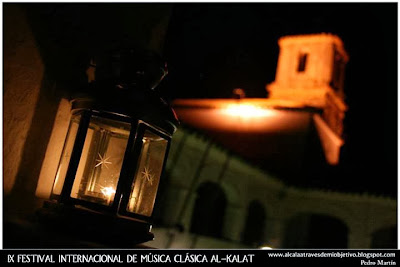
Last night we had the first proper rain since May, clearing the dust from the air and sparking off the growth of lush winter grass which our livestock farmers depend on.  We don't get polite little showers here, it comes down by the bucketful ( llueve a cántaros ) and soaks you to the skin in  seconds. Back in May the forecasters were predicting the coldest summer in Spain for 200 years .  Well, if that was a cold summer, bring on some more please.  Daytime temperatures peaked in the low 30s Celsius (90s Fahrenheit) and we didn't get that extended sweaty humid period that usually keeps us awake on August nights. As always, Alcalainos took full advantage of the summer months to celebrate their fairs and festivals.  Here are some pictures recording the summer of 2013 by a young local photographer, Pedro Martín Sánchez, more of whose excellent work can be seen on his blog Alcalá a través de mi objetivo . 9th International Music Festival Candlelit concert ...