Posts

Showing posts with the label flamenco

Festival Al-Kalat - Alcalá's annual music festival

Image
In August 2004 Matthew Coman, an Englishman who had made his home in Alcalá, staged the town's first music festival.  He invited colleagues from a group of classical musicians, known as The Soloists of London, to spend a week in the pueblo and give concerts in the beautiful patio of the Sagrada Familia school (SAFA), a former convent on the Plaza Alta. The Soloists of London in the SAFA patio Poster from the fifth festival in 2008 In 2009 the festival including a performance by a group of young musicians from around the province, after a week of rehearsals under Coman's supervision. This  inspired a painting by the late Jesús Cuesta Arana, which was used for that year's poster. Poster artwork from the 2009 festival, by the late Jesús Cuesta Arana Young musicians rehearsing for their concert For the following few years the festival remained focused on classical music, even staging a production of La Traviata in the church. Tickets weren't available in advance in those da...
Spain's "final solution" 1749: how they tried to get rid of the gypsies

Image
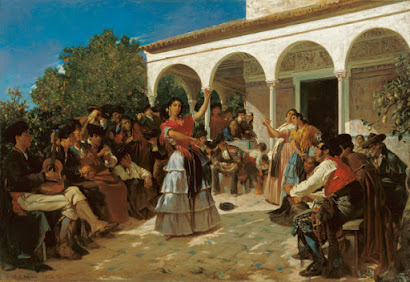
Gitano culture and language are so closely intertwined with those of Andalucía as to be almost indistinguishable. But Spain has long had an ambiguous attitude towards the Romani people, saluting them as bearers of folkloric traditions such as flamenco and sevillanas with one hand while clearing them out of their homes with the other.  19th century romantic stereotype of gitano culture The word "gitano" is derived from egiptano , an archaic Spanish word for Egyptian (today they use egipcio ). The English word "gypsy" has the same root. However they originated from the Punjab region in northern India, nowhere near Egypt.  The reason for the misnomer is unclear - some may have entered Europe via Egypt, or perhaps European mistook them for Egyptians because of their appearance.  The first Romani arrived in Spain early in the 15th century, travelling in large family groups, and in 1425 were given a guarantee of safe conduct by the King to make a pilgrimage to Santiago de...

Zambomba in Bar Cristobal (now el Piojo) around 2006-2007

Feria in the '50s

Image
Alcalá's August fair is one of the highlights of the festive calendar, with friends and families getting together for four days of eating, drinking, loud music, dancing and general merriment.   But it wasn't always like that and it wasn't always in August.   Francisco Teodoro Sánchez Vera , an alcalaíno now living in Catalonia, describes the ferias he remembers from his childhood.   Read the original Spanish version here  During the years of my childhood and adolescence in Alcalá, there was no fair in August. It was celebrated in May, and it was very different to nowadays. In those days the girls didn't wear dresses with frills, and you didn't hear sevillanas 1 on the Paseo de la Playa. We had song and dance del gazpacho 2 to the rhythm of verdiales or pasodobles, played by local groups with well-known musicians like my friend Jésus Sánchez, father of the great Alejandro Sanz. 3 There were also f lamenco shows in the Cinem...

Diverse Divas

Image
Spain, and especially Andalucía, adores its musical divas.  One of the favourites, Marifé de Triana, died yesterday  on the Costa del Sol aged 76, and already a chapel of remembrance has been set up at Torremolinos town hall for her many fans to pay their respects. Marifé (born María Felisa Martínez López) was one of the queens of copla , a uniquely andalusian genre that draws on flamenco, folk songs and zarzuela , sung with a melodramatic passion and usually accompanied by an equally melodramatic orchestral arrangement.  Here she is singing La Loba (the she-wolf). Copla andaluza became popular in the 1940s, and is as popular today as it ever was. On Saturday evenings during the winter months, Canal Sur TV broadcasts the Andalusian equivalent to The X Factor, Se llama copla , which is watched by millions.  The contestants are mainly women, and the costumes are as dramatic as the songs. Contestants in Se Llama Copla Rocío Jurado Another great co...

An evening at the Beaterio

Image
At the heart of Alcalá de los Gazules, literally and figuratively, is the Beaterio de Jesús, María y José. It is tucked in between the church of San Jorge and the remains of the castle, at the highest part of the town. The entrance is in the narrow street which bears the name of its founder, a priest called Diego Angel de Viera. The Beaterio opened in 1788 to provide free care and education for those in need. Today, this takes the form of a hospice for the elderly, and a school with boarding facilities for kids who don't have a stable home life, both run by a small but energetic group of nuns and volunteers. There is also a delightful chapel and a walled garden with spectacular views over the town and the surrounding countryside. Last Friday we attended a concert there to raise funds for a well to provide clean water and irrigation for a village in Kenya, part of a project undertaken by three Kenyan nuns currently staying at the Beaterio.  It was a great chance to...

Flamenco in Alcalá

Image
We live deep in flamenco territory.  You hear it blaring from cars, shops and houses; builders sing it while they are working; I even saw an old boy in a bar late one night, wailing along with whatever he was listening to on his iPod.  At the summer ferias women of all ages, shapes and sizes dress up in their flamenco outfits and dance sevillanas .   El Camarón de la Isla, probably the most famous flamenco singer or cantaor of all time, lived and died just up the road in San Fernando, or La Isla de Leon as it was once known.  (We heard one of his many relatives singing in La Sacristía bar in Alcalá last Christmas, but he was a bit the worse for wear.)  A lot of Spanish pop music is influenced by its rhythms and modes, and genres such as  flamenquillo  and flamenco chill make good listening - check out the bands Chambao or Mártires del Compás. Traditional flamenco comprises three strands, cante, baile and toque - song, dance and guitar. The...

Flamenco

Extract from a superb flamenco concert in the patio of the Sagrada Familia school, August 2009, featuring singer Argentina and dancer El Junco .