Posts

Popes, protests and pilgrimages

Image
Spain is in danger of losing her faith, according to Pope Benedict, concerned about falling church attendance, gay marriages, abortions, sex education, the morning-after pill, divorce and even the teaching of evolution over creation, in a land known for centuries as one of the Catholic Church's highest bastions of dogma. El Papa believes it is up to Spain's youth to reverse the trend towards "aggressive secularism", and he had his speech all ready to deliver to 1.5 million devout youngsters in Madrid at last month's International Youth Day gathering, before a violent thunderstorm brought an abrupt end to the proceedings.  One can't help but wonder about that Hand of God ... Meanwhile, people concerned about Spain's other crisis (the economic one) were angry about the estimated €50 million cost to the taxpayer of His Holiness's visit to Madrid at a time when austerity measures are seriously starting to bite.  A peaceful protest was forcibly remov...

Sandias, Galias and Skin of Toad

Image
Victor, our local greengrocer It's the melon season.  The local shops are full to bursting with great green globes, rolling off the counters and piled up on the floor. Men with van-loads of them are knocking door to door. Little old ladies totter out of the greengrocer's with a carrier bag in each hand, containing watermelons that weigh almost as much as they do. Melons have been enjoyed by humans for at least 4,000 years.The Prophet Muhammad is reported to have said: "Whenever you eat fruit, eat melon, because it is the fruit of Paradise and contains a thousand blessings and a thousand mercies. The eating of it cures every disease." The word is probably derived from Melos the Greek Cyclades Island best known for the Venus de Milo). All melons come from the Cucurbitaceae family. They are closely related to cucumbers and squashes, but due to their sweetness they are used as fruits rather than vegetables. Apart from the watermelon, the many varieties around...

The Rat Run

Image
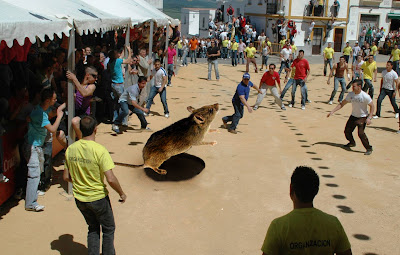
Last night was one of those soupy, humid August nights you get in Alcalá when there is no wind to stir the air and the white buildings, like giant storage heaters, release the heat they absorbed during the daytime. As soon as it got dark we dragged ourselves down to the Paseo de la Playa for a beer, and sat outside Siglo XXI chatting to the owner, Manolo, about the UK riots which he mistakenly believed marked the beginning of the English Revolution. As usual on a Saturday night  the whole town was out; small children raced up and down the Playa on their rollerblades and tricycles, teenage girls were dressed to kill in their micro-skirts and six-inch heels, their male prey chatted to each other pretending not to notice, while their parents and grandparents clustered round tables in front of Pizarro's Restaurant in large noisy groups, putting the world to rights. Suddenly we heard shrieks and shouts from the direction of Pizarro's.  Children were sprinting in all directions...

How now, red cow?

Image
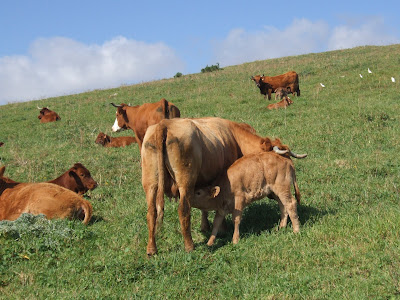
Alcalá is surrounded by cattle, and not just the scary great black toros bravos - fighting bulls - bred around Medina Sidonia and destined to face Death in the Afternoon. This land produces some of Spain's finest beef. Drive out in any direction and you will see large herds of reddish-brown beasts with huge white horns, peacefully grazing or being rounded up by mounted vaqueros . There is usually a flock of cattle egrets in attendance, and occasionally a tiny calf just finding its feet. These are the raza retinta , our own native breed, and they are very special. The word retinta refers to their colour, which can range from chestnut red to dark brown. The breed Bos taurus Turdetanus (I kid you not) probably originated in North Africa, but has been in the Iberian peninsular since ancient times and can be seen in cave drawings. Today it is found mainly in Andalucia and Extremadura, though there are small herds in other parts of Spain including the Balearics. Retinta cattle...

The day they shot the Mayor

Image
Seventy-five years ago this month, the Mayor of Alcal á de los Gazules was executed by a firing squad.  His crime was failing to support the military coup against the elected Republican government. Antonio Gallego Visglerio was born in Alcalá in 1893.  He ran a bar, the Cafe los Serios , and also owned a lorry used to transport goods.  He was elected as a Councillor in July 1931, following the establishment of the 2nd Spanish Republic , and became Mayor in October 1933, remaining in office until the socialist administration was dismissed by the right-wing provincial governor Luis de Armiñán a year later.  Gallego was reinstated as Mayor, along with the rest of the elected council, following the Popular Front victory in the 1936 elections. Gallego wrote a document outlining his hopes and plans on being elected to serve the newly formed Republic after many years of dictatorship and the collapse of the monarchy.  He describes the difficult and ...

Things with wings

Image
On the long summer evenings the skies above Alcalá come alive with an aerial ballet of swifts, swallows and house-martins.  We sit on our roof terrace and watch them swooping and soaring, hoovering up flies on the wing.  They are often chased by our resident lesser kestrels, but they rarely succeed in catching one.  White cattle egrets flap lazily along the river valley towards their nocturnal roosting tree, usually in V-shaped groups of a dozen or so, but with the occasional latecomer anxious to catch up with the flock.  Doves and pigeons are here in abundance, nesting in the special pigeon-holes made for them in the rocks of the Coracha above us. Then just before dusk the bats appear, taking over the flycatching from the hirundines as they return to their nests.  After dark, the whoo-hoo of the tawny owl can often be heard, or the distant screech of a barn owl. Cicadas chirrup in the bushes, and some temporally challenged cockerel will usually sound his quiq...

Ten reasons to go to Alcalá de los Gazules

Image
Diez Razones (Ten Reasons), a TV show made by Canal Sur, spotlights a different locality in Andalucia each week, and last night it was about Alcalá de los Gazules.  You can watch it online here . Their ten reasons are: EL MUSEO VIVIENTE - the "living museum" run by the Adult Education Centre .  A bit misleading this, as it's only open one week of the year!  LOS MALETILLAS - tributes to famous bullfighters from Alcala.  A rare chance to see inside the town's old bullring, the outside of which was converted into flats years ago. EL GAZPACHO CALIENTE - hot and thick, the traditional way to eat gazpacho in the winter. LOS EXVOTOS - the enchanting and poignant drawings and paintings offered in thanks to Our Lady, lining the walls of the Sanctuary chapel. LOS ARTISTAS INGLESES - the two English artists shown here are musician Matt Coman, who runs the annual classical music festival, and painter Andy Russell who gives art lessons to locals and visitors...